Wednesday, July 17, 2013

ITALIAN LAKES: GARDA, ISEO, COMO, MAGGIORE


Peschiera del Garda

Walls surrounding Peschiera del Garda 
Ruins from the Roman era
The northern lakes of Italy, formed by glaciers at the end of the last Ice Age, are incredibly beautiful. Over the course of two and a half weeks, we visited 5 of them.  
Borghetto

First stop was Peschiera del Garda at the foot of Lake Garda.  At 34 miles long, it is the biggest lake in Italy. The town was once an important military center and is virtually an island in the lake surrounded by 16th century fortress walls.  However, Peschiera del Garda's history goes back to the bronze age and the foundations of buildings from the Roman era were recently discovered. 


Borghetto on Mincio River
Close by is the charming little hamlet of Borghetto. Situated on the Mincio River, it is listed as one of the most beautiful villages of Italy. 

Next stop was Lovere on Lake Iseo, smallest of the major Alpine lakes at 20 miles long.  It is not as well known as Lakes Garda, Maggiore and Como, but just as beautiful.   
Medieval center of Lovere


Lovere sits on the northwest corner of Lake Iseo with stunning views of the towering peaks that surround the water.  It would be impossible to drive around the lake without the many long tunnels that cut through granite mountains 

Our hotel offered a walking tour of the city where we saw the 3 different sections of the town: medieval, renaissance and modern.  They must not get many Americans here.  Our young tour guide was so surprised that we were from the U.S. that he kept pointing us out to locals along the way saying, "From Floreeda.  Floreeda!"  
Entrance to tunnel through mountain on Lake Iseo

In the middle of Lake Iseo is Mont Isola, the largest European lake island.  We took the passenger boat there one day stopping at lakeside villages along the way.  On the island, we were able to follow a tranquil path along the water from one village to another. 
Menaggio on Lake Como

Our hotel on the main square
View from our terrace

Lake Como is Italy's 3rd largest and deepest lake.  It has long attracted the rich and famous - artists, writers, aristocracy. There are many huge, elegant villas along the shores of the lake. Nowadays it may be best known because George Clooney has a home there.    


We were able to tour all the villages in the central area of the lake by boat.  I think Bellagio with its elegant shops and Menaggio (where we stayed) were the nicest.  Our room overlooked the main square and the lake.   

From Lake Como, we drove to Lake Maggiore, the longest of the lakes (about 40 miles) but second in overall size. Partially in Switzerland, Lake Maggiore also attracted the rich and famous in years gone by.   It was featured in Ernest Hemingway's novel "A Farewell To Arms."
Promenade in Bellagio


Bellagio on Lake Como
While we were in the town of Stresa, we took the cable car and chair lift to the top of Mount Mattarone, almost 5,000 ft above sea level. Unfortunately, the haze prevented clear photos but we could see the shadowy outlines of several lakes surrounded by towering mountains.   

We found the town of Stresa to be a little too touristy so cut our visit short and moved on to the lovely lake of Viverone.  Well off the beaten tourist path, we enjoyed a peaceful, relaxing few days there.  
View of Stresa & Maggiore from cable car


On top of Mount Mattarone

On July 19, we say "Arrivederchi, Italy" and drive into France.  After 2 months and 4 days in this beautiful country, we cannot answer the common question:  What was your favorite?  We loved the variety of our stops:  the northern Italian Riviera, Tuscany, Umbria, the Adriatic coast and the Alpine lakes.  We found the hosts and hostesses of our various lodgings to be incredibly warm and hospitable.  More often than not,  when we asked the check out time, the answer was, “When do you want?” 
Pool at Hotel Marina

View of Lake Viverone from hotel
Italy, like most of Europe, is enduring financial hardship at this time.  You would never know it!  We saw more Audis and BMWs on the roads here than anywhere.  Coming from Palm Beach County, that’s saying something.   Of course, the young people suffer the most; unemployment is high.  Many long to come to America - especially Miami thanks to CSI Miami. 

There is still so much more of Italy to see that we are already thinking about coming back next year.  In the meantime, we look forward to saying "Bonjour, France." 
.


Tuesday, July 2, 2013

SAN BENEDETTO DEL TRONTO and RIMINI

View from our hotel in San Benedetto del Tronto
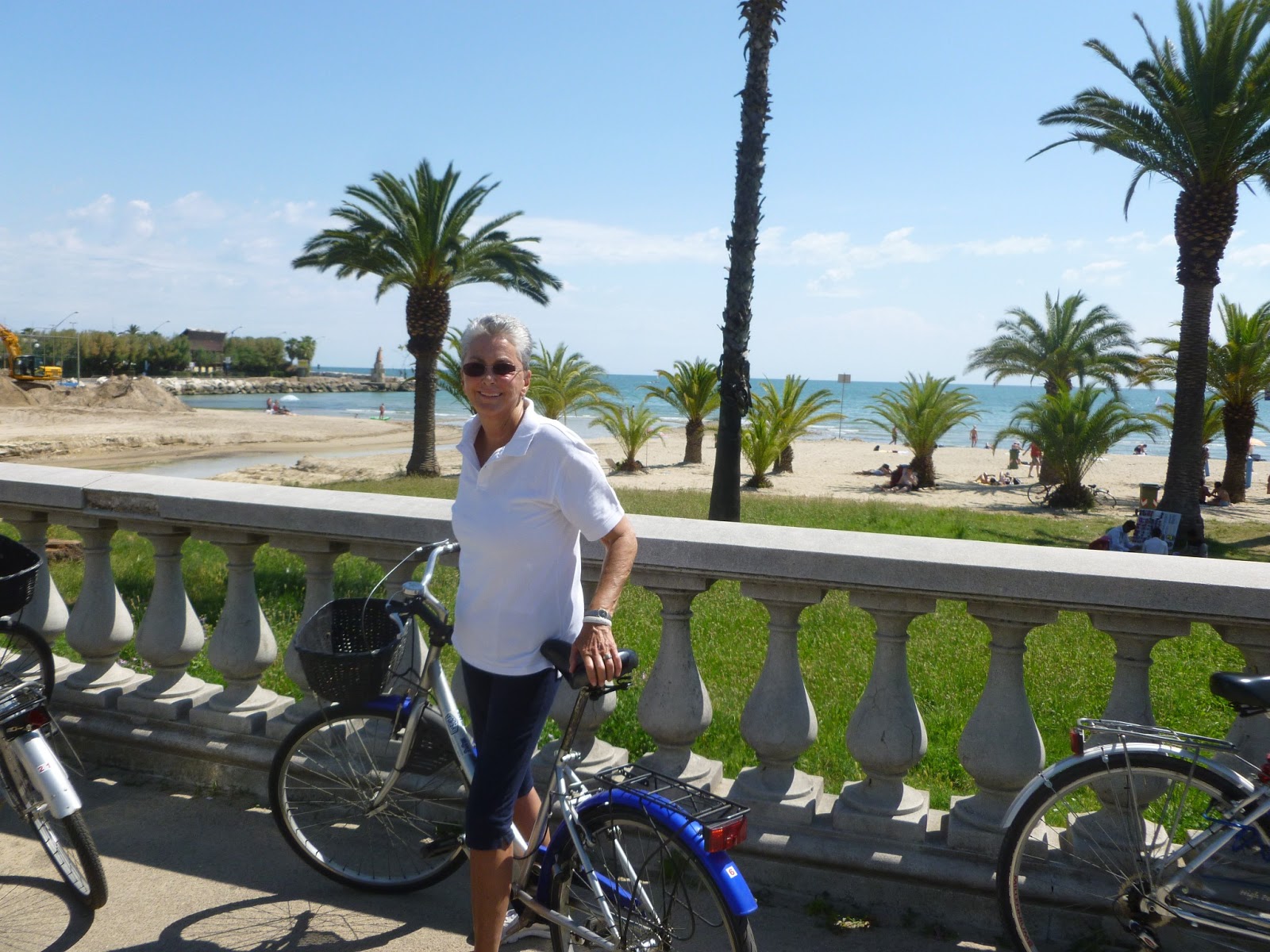
Biking in San Benedetto del Tronto

There are close to 62 million people in Italy and during the summer, many of them can be found on the east coast of Italy.  One seemingly endless beach runs along the Adriatic Sea.  Lined up across the sand are beach chairs and umbrellas...  thousands of them.   


Italian Water Fountain
Families frequently travel together - children, parents, grandparents and even great grandparents.  By the time we arrived, school was out and children were everywhere.  It is hard to believe that the 2012 birth rate in this country was only 1.4 -- well below the replacement level of 2.1 children per couple.   


The first coastal resort we visited was the town of San Benedetto del Tronto situated at the center of the Italian peninsula.  The name of our hotel was quite fitting: Hotel Relax.   A very long biking and walking path ran beside the beaches, around the marina and through the town.  We enjoyed riding different sections of it every day.   
Arch of Augustus 27 BC - Entrance to Rimini's historic center


After several days, we moved up the coast to Rimini, the most popular of all the beach resorts.  Here, as at Hotel Relax, all our meals were included.  For the most part, the food has been good although I can't understand how people eat as much pasta as the Italians do and not weigh 330 lbs.  

Restored wall surrounding town of San Marino
Rimini is renowned for its 15 km long, sandy beach. Over 1,000 hotels serve the tourists who are almost exclusively Italian.  Founded by the Romans in 268 BC, Rimini has an impressive old city and is also proud to claim Federico Fellini as its native son.    

View over the valley from Mount Titano 
Palazzo Pubblico San Marino


Only 20 minutes by car takes you from Rimini to the Republic of San Marino, the 5th smallest country in the world.   Surrounded by Italy and only 24 square miles in area, it has much to boast about.  It is the oldest republic in the world, has the lowest unemployment rate in Europe and no national debt.  It is ranked #3 of 191 nations in healthcare.  


Charming walkways through San Marino 
Founded in the 4th century, San Marino sits atop Mount Titano and is home to about 32,000 people. The old city - also called San Marino - is a UNESCO World Heritage site and beautiful to visit.  Even though it was a cloudy day, the view from  Mount Titano which is 2,424 feet above sea level, was magnificent. 

 Now we leave behind lazy days lounging on the beach and head north to Italy's lake region.       


t


Thursday, June 20, 2013

PERUGIA and SPOLETO


Villa La Grotta
Vlad & Simone manage Villa La Grotta
Cathedral of St. Lorenzo in main square of Perugia
About 12 miles from the city of Arezzo is a villa built in the late 1700s as residence for a noble family.  It is now a guest house and we had 5 pleasant days there as part of a Travelzoo package.  Slightly away from the main tourist areas, this is truly the heart of Tuscany -- the air is crystal clear and the countryside gorgeous. The package included a visit to an organic farm and winery and to an elegant estate and winery owned by the Ferragamo family, but it was the managers of Villa La Grotta, a young couple from Romania, who made this stop memorable with their warmth, kindness and humor. 


Fontana Maggiore between cathedral and Palazzo dei Priori
Then it was on to Perugia.  Best known for chocolate, Perugia also has a wonderful old city. Built atop a hill, it is best reached by parking below and taking a series of escalators up.  They pass through the ruins of a medieval fortress.   A beautiful fountain built 1278-80 stands between the cathedral and the building that housed the original governing bodies of the the province.       

Convent of 1700s converted to apartments
Our second floor terrace overlooking pool 
We stayed just outside the city in what has to be the most beautiful setting of our various lodgings.  A convent of the 1700s was converted into modern apartments.  Since it was not too busy, the owner upgraded us to the 2 bedroom terrace apartment which had a fantastic view of the surrounding meadows and mountains.  We could even see the old city.

Spoleto was our favorite old town.  Different parts of the city are connected by narrow alleys with arches and cobblestone streets. They go in every direction but all alleys eventually lead to a piazza and a way back to where you started.   


Spoleto began as a colony in 241BC.  Our hotel overlooked the ancient Roman Theater. Today it is best known for The Festival of 2 Worlds, an incredible 17 day cultural event with opera, ballet, concerts, cinema, workshops etc. held in venues all over the old city. 
Typical Alley with arch in Spoleto


The Arch of Druso 23Ad
Spoleto is also renowned for Rocca Albornaziana, a fortress that was  commissioned by the popes around 1360 to win back the Papal territories that had been lost to Avignon, France during the approximately 70 years that Avignon was the papal seat.   From here you can see the city and far beyond.  St. Francis of Assisi said, "Never had I seen anything more pleasant than my Spoleto valley." In 1817 the fortress became a penal settlement and eventually a high security prison.  Massive restoration led to its opening as a museum in 2007.  
Rocca Albornoziana

Rocca Albornoziana courtyard
The Bridge of Towers which was built in the late 1300s is outside the fortress.  It was the aqueduct that carried water from the mountain into the city.  We walked across it one day marveling at how they managed to build the columns so high.  It is  considered one of the greatest masonry constructions of the ancient world.  


Frescoes on 2nd floor walkway overlooking courtyard
At the foot of a long, wide staircase, the Cathedral of Santa Maria Assunta is a stunning sight.  It was built in the late 12th century over the remains of other churches.

Summer has finally arrived and we are happily heading toward Italy's east coast and a couple of beach towns.  But Spoleto was a wonderful city in which to celebrate our 18th wedding anniversary on June 18.  


1st century Roman Theater 
Bridge of Towers Aqueduct
Cathedral of Santa Maria Asunta


Saturday, June 8, 2013

REGGIO EMILIA, CHIANTI COUNTRY and SIENA


Hotel Posta in upper right corner
Thanks to a very reasonable Luxury Link package we had 3 days in a junior suite at the Hotel Posta in Reggio Emilia.  It became a hotel in 1515 but the building's history dates back to 1280.  It has been beautifully modernized inside and sits at the corner of the biggest piazza in town.  The central area of Reggio Emilia is filled with pedestrian walkways and public squares and most of them are filled with people on foot or bicycle – especially on Fridays and Saturdays when almost every square hosts a market.   
Wheels of parmesan cheese

The area is best known for the production of Parmigiano-Reggiano cheese.  It is only produced in this general area and they claim  “The secret of such goodness originates in the place of origin, in the natural feed, and in the high quality milk with no additives.”   There are strict regulations regarding the feeding of the 270,000 cows that produce the milk that goes into making the cheese.  It takes almost 160 gallons of milk to make one wheel of Parmigiano-Reggiano.   Once the cheese is made, it ages for a minimum of 1 year but usually 2 years or more.  So think of this the next time you sprinkle your pasta with parmesan cheese!  
Our 1st floor corner unit in Chianti country
With our host at an Italian winery 
We went from one extreme to the other: the heart of a busy city and one of the oldest hotels in Italy to the quiet Tuscan countryside and one of Italy's newest hotels in the Chianti area.  Our big studio apartment with full kitchen overlooked a beautiful pool.  Here we enjoyed the beautiful Tuscan countryside, quaint little towns and a couple of real Italian family run wineries.  
Piazza del Campo site of the Palio de Siena horse race


Palazzo Pubblico on Piazza del Campo built 1338-48
The charming town of San Donato
We didn't have to travel far to our next destination outside Siena.  We spent a day in the city best known for its massive cathedral and the Palio di Siena - the annual horse races around the Piazza del Campo.  On 2 separate days every summer, 10 jockeys riding bareback circle the sloping piazza 3 times in about 90 seconds. The race is fast and treacherous, and horses often reach the finish line without a rider.

Siena's Duomo (cathedral) was built in the 12th and 13th centuries.  The sanctuary is huge and the walls and ceiling of the library are covered with magnificent frescoes. 

Siena's Duomo
Cathedral Library


Every town - no matter how small - has a big church
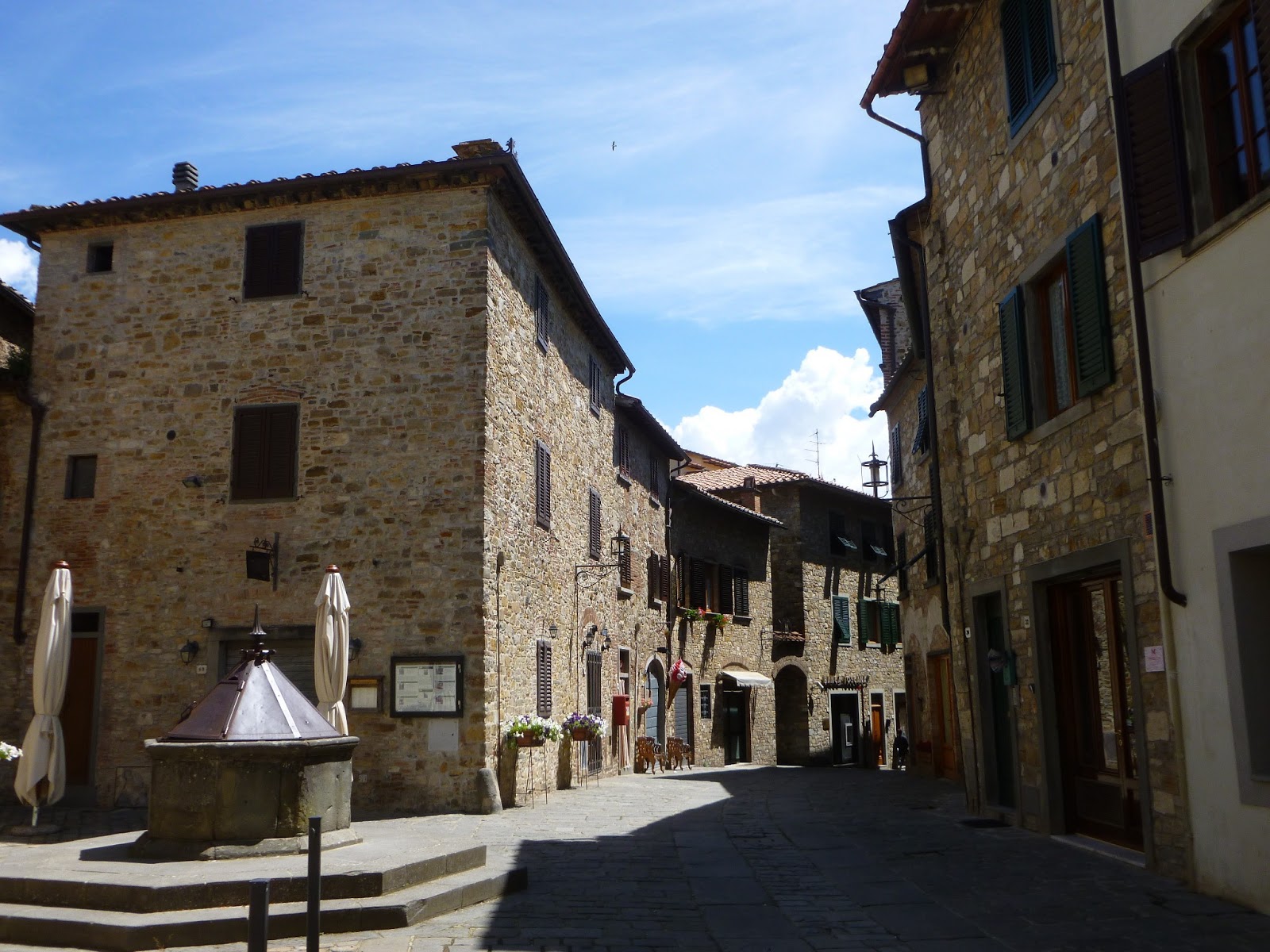
Since we have been to most of the major cities of Italy in the past, this time we are enjoying driving the backroads and visiting tiny, hilltop villages with the ruins of ancient churches.  It has been an unusally wet, cool spring but the rains have finally eased.  Vineyards, green meadows and bright flowers sparkle under blue skies.


I love the picturesque windows

Tuesday, May 28, 2013

RAPALLO and CINQUE TERRE

View from our terrace
About 20 miles east of Genoa and just two villages away from well known Portofino is the lovely Italian Riviera town of Rapallo Italy.  Our room on the 5th floor of an older hotel opened onto the roof top terrace which provided a gorgeous view of  the city and harbor plus lounge chairs to relax in after busy days of touring.  

View over Rapallo & Margherita
Montallegro Cathedral
We seem to catch the weekly outdoor markets in every town and there was one here the day after we arrived.   We wandered past the booths set up along the seaside promenade, then took the funicular to the top of the mountain.  1,800 feet up, we had a magnificent view of Rapallo and the adjacent town of Santa Margherita.  We walked up to a beautiful cathedral that had been built here to honor an apparition of the Virgin Mary which appeared to a peasant in 1557.  
Portofino
Brightly painted facades
Upon returning to town, we boarded the boat to Portofino.   Afer strolling the small, colorful town, we chose a restaurant for lunch.  As fate would have it, we sat beside a couple from Monacco who had owned a jewelry store in Palm Beach for many years.  At their suggestion, we tried the pesto linguine, a local specialty.  It was delicious and unlike any pesto dish we’ve had in the States.  Also characteristic of the Ligurian region are brightly painted facades and fake windows on the buildings.  

Then there was the morning Ron couldn’t find his driver’s license.  After turning the room upside down, we finally concluded that it was, in fact, lost.   We were told to make a report at the police station which was just around the corner from our hotel.  Afterwards, as a last hope, we stopped at the supermarket across the street to see if he had dropped it there.  Success!  One of the young clerks had found it and given it to his colleague to take to the police station.  It was there the whole time Ron was making out the lost
License returned thanks to them
report!  This time when we returned to the police station, we had to wait about ½ hour while a ‘found’ report was made.  We were so happy to get the license back that we returned to the store to thank the lovely young men who had saved the day! 

Our little Agriturismo in Levanto

After several pleasant days in Rapallo, we drove to Levanto,  just north of the Cinque Terre.  On the edge of town is an Agriturismo (combination farm and B&B) run by a sweet young couple.  They produce wine, grappa, olive oil and 32 different flavors of jams.  

Portovenere

Saint Peter's Church Portovenere
The area known as Cinque Terre is composed of 5 small towns linked by hiking paths.  They are overrun with tourists.   We opted to take a train and bus past the Cinque Terre to the less popular but much prettier town of Portovenere.  Stretching into the sea with a church built atop ancient fortifications, Portovenere was once a favorite of D.H Lawrence and the Romantic poets Lord Byron and Percy Bysshe Shelley.  


The highlight of this stop was hooking up with Monica and Lee in the Cinque Terre town of Vernazza.  We met last March at a retreat we all attended in Temecula, California.  We had discovered that they too were homeless and doing an extended overseas trip.  This was the closest we would come to crossing paths. What fun it was to see familiar faces and trade stories -- not to mention speaking English without charades!  

Dinner with Lee & Monica in Vernazza