Saturday, June 21, 2014

CROATIAN COAST

Lion of Venice gate into Zadar 's old city   
Zadar's cathdral
Alfred Hitchcock thought the sunset in the ancient city of Zadar was the most beautiful in the world.  With crystal clear waters and numerous islands off its coast, Zadar is certainly scenic but it is also very historic. Zadar is
Church of St. Donat 9th century
3,000 years old and the 5th  
Ron on the steps of the water organ 
largest city in Croatia. Zagreb, the capital, is the largest.  

The city gates and walls around Zadar's medieval center were built when the land was part of the Roman Empire.  Numerous ruins and 
Roman ruins
monuments from that period remain.  More recent additions to the old city are the University of Zadar, a wide walkway around the city and a water organ.  It is an interesting and lovely town to walk around.  We also enjoyed a ferry ride across to the island of Preko.
Rogoznica


Our apartment building in Rogoznica
Undoubtedly, the most serene place we stayed was Rogoznica.  Our residence was at the water's edge with a large balcony to enjoy the view. Since the building was not yet full, the owners kindly upgraded us from a studio to a 2 bedroom apartment. It was about a 15 minute walk on a gravel path along the sea into town which is known for having one of the safest, most sheltered bays on the Adriatic.  
View from our balcony in Rogoznica


The bay of Maraska
Baroque church in Maraska town center
Our hotel in Maraska beside the promenade and beach

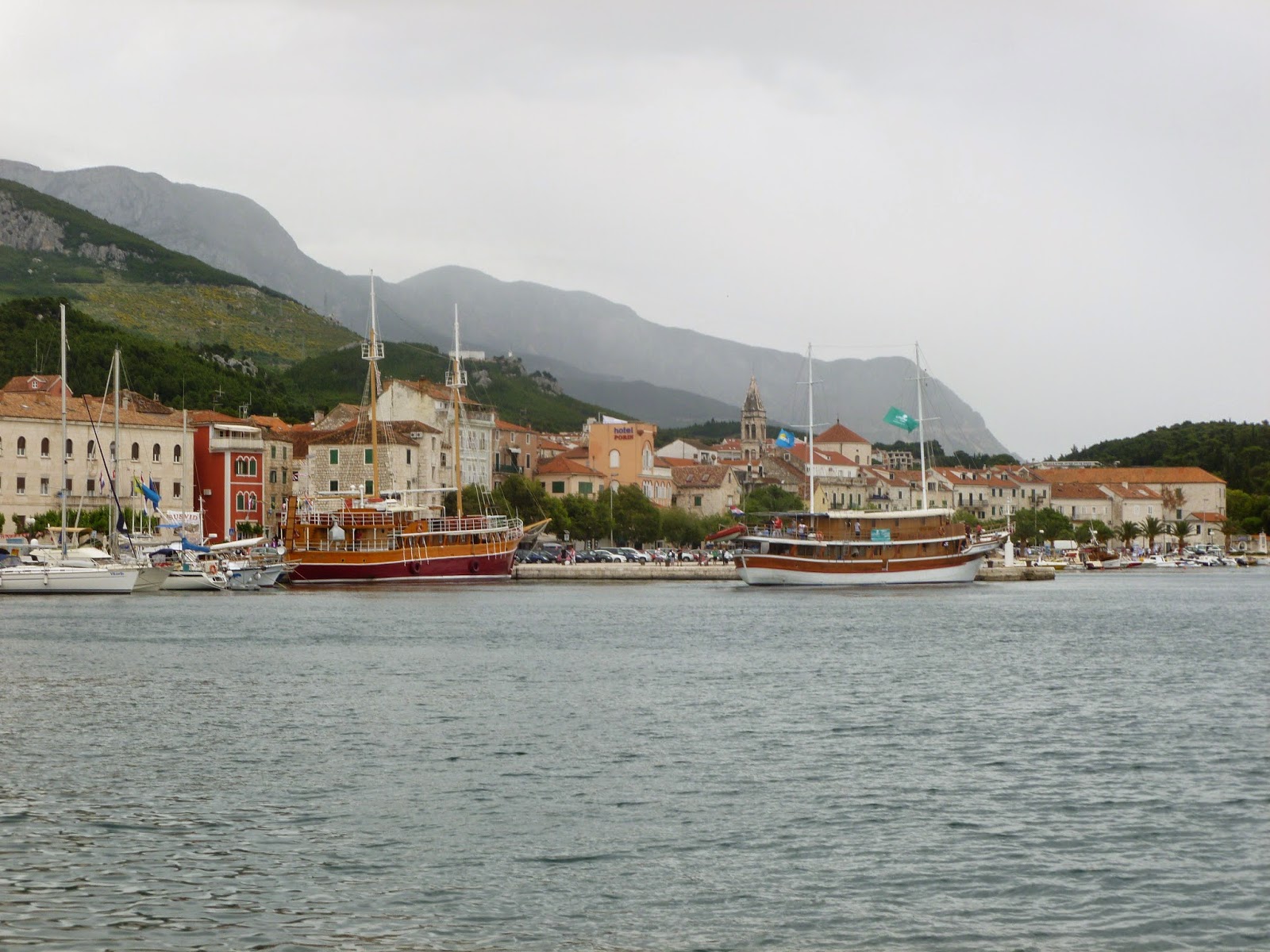
Continuing south along the coastline, we came to one of Croatia's most popular vacation areas, the Maraska Riviera, a 38 mile stretch of small towns and nice beaches.  
The town of  Makarska is in 
Clock tower in Trogir 
the center of the Riviera with sandy beaches and a sheltered bay on one side and massive Mount Bioko on the other. The rocky cliffs are 5,770 feet high and hover over the town like protective giant. We were fortunate to again take half board at our hotel there. They offered an excellent 4 course dinner at their restaurant which was right on the promenade overlooking the sea. 
Trogir's fortress
Lookout tower Trogir
Our final stop on the coast was Trogir. In the 3rd century B.C., Trogir was founded by Greek colonists 
Our apartment building in Trogir
View from our apartment in Trogir
and has continually been inhabited ever since.  Romans and Venetians added to the architecture over the years and in 1997, Trogir was added to UNESCO's World Heritage sights as the best preserved Romanesque-Gothic town in central Europe.  Situated on a small island, its narrow streets lead to ancient towers, churches and a fortress.  The medieval core is surrounded by walls.  On the outskirts are a daily green market and permanent market stalls.  

From Trogir, a pleasant one hour boat ride took us to Spit, Croatia's second largest city.


One of the gates into Palace complex
Central courtyard  of Diocletian's Palace


15BC Egyptian sphinx at the Palace courtyard  


The bell tower of St Duje Cathedral 


The main draw here is Diocletian’s Palace, also a UNESCO World Heritage site.   The Emperor Diocletian chose the land beside Split's harbor for the construction of his retirement home.  Begun in 293 and completed 10 years later, it was  actually a small city. 

The Cathedral of St. Duje was built in the 13th century and stands next to the original site of the emperor's mausoleum. On the other side is a black granite sphinx that Diocletian brought back from conquests in Egypt.  

Now we head inland to visit two of Croatia's national parks.  


Saturday, June 7, 2014

CROATIA: WOW!


Hotel Lone pools 
Hotel Lone's beach front 
We arrived in Croatia on May 25th and quickly fell in love with the country.  It is absolutely beautiful! Though many of the buildings in the cities are from the post war era, modern resorts have been built along the water to accommodate the growing tourist trade.   
The town of Rovinj

Our balcony and adjacent whirlpool

We stayed at four different locations on the Istrian peninsula, the largest peninsula in Croatia.  Slightly south of Trieste, Italy, Istria juts out into the northern Adriatic Sea.  The land was originally an island but the channel that separated it from the mainland was filled in during the 1700s.  

Our first stop was in the small, picturesque town of Rovinj.  We had four lovely days at Hotel Lone, our last Luxury Link special for a while. The hotel is ultra chic and the grounds are beautiful with several connected pools and a beach area situated on a cove. It is walking distance to town on one side and has a park on the other side with bike and walking trails.  Our room opened onto a patio with a whirlpool that ran the length of the balcony and overlooked the pool and forest.
The pool at Histria Park Plaza Hotel in Pula

TRAVEL TIP: Although many of the Luxury Link offers are expensive, there are good deals to be had -- especially if you travel in the off or shoulder season.  The hotels we have stayed at have been reasonable and the package usually includes perks like breakfast, a massage, dinner, resort credit to spend.  The auction price is better than the Buy Now price, so I always call the hotel ahead to make sure they have availability on our preferred dates. 

View from our balcony across marina to Pula

Typical Croatian beach
We spent another four days at a hotel in Pula.  Pula is an ancient city that reached its zenith under Roman rule in 46 – 45 B.C. Emperors and nobility spent summers here. The 6th Roman amphitheater was built in Pula; we saw the massive structure on our way through town.  There is evidence of humans in the area one million years ago. 

At this hotel as well as the following two, we booked half board which means that breakfast and dinner were included, a nice convenience.  
The village of Rabac
Beach and walkway in front of our hotel in Rabac
 All the hotels had excellent
service and outstanding wellness areas with indoor pool, sauna, steam and whirlpools.  We would happily return to any of them but first choice would probably be our third stop - the Valamar Sanfior in Rabac. There was a beautiful walkway along the water into a small, cute town and the food at the hotel was superb. 

View from our hotel in Opatija
Like so many resort towns along the water, Rabac was originally a small fishing village and the shore is dotted with stone covered beaches. People bring chairs or mats or just stretch out on the large rocks that dot the coast and surround the incredibly clear water. 

Park in center of Opatija originally part of ...
Our fourth and final stop was the small city of Opatija, the first seaside resort on the Istrian Peninsula. Winding along the water are a promenade, outdoor restaurants, a beautiful park, and hotels and villas that exude the beauty and luxury of when they were built in the late 19th and early 20th centuries to accommodate Austrian nobility.  Villas also dot the hills surrounding the town.  Most of the ones on the water have been converted to luxurious hotels.
this villa

Croatia has changed hands many times over the years.  In 1947, it was ceded to Yugoslavia but fought for and finally achieved its desire for independence in a war that lasted from 1991 – 95.  The country became the 28th member of the European Union on July 1, 2013.

Croatia has a population of slightly less than 4 and 1/2 million and ranks as the 18th most popular tourist destination in the world.  However, it is gaining recognition and I suspect it will soon climb higher.              
Seaside villa converted to hotel
Opatija's waterside promenade 


                            Villas  from Opatija's Belle Epoque converted to colorful hotels

              Now we begin our journey down the Croatian coast.


Saturday, May 24, 2014

ITALY: NORTHEAST COASTAL AREA

View from our hotel balcony Cervia
From Torgiano, we made our way over to the northern coastal area of Italy.  The entire east coast of Italy runs along the Adriatic sea and Italians flock to the countless beach resorts in July and August, but things were pretty quiet when we were there in May. 

Infinity pool at Villa del Mare Hotel Cervia
Painted boats in Cesenatico

Our first stop was Cervia, once famous as a salt producing city but presently better known for its beaches and spas.   Like most Italian seaside towns, the paved pathway along the beach goes on for miles and we took advantage of it by foot and bicycle.  We stayed at a beautiful, modern hotel with an infinity pool on the roof and a wide balcony overlooking the sea.  Just a few miles south of Cervia is Cesenatico founded in 1302 and known for historic fishing boats with brightly painted hulls displayed in the canal that runs through the town.  
Grado's wide beaches
Marina in the center of Grado
Ancient ruins and mosaic tiles in Grado

Proceeding up the coast, we stopped in Sottomarina for a few days. It is part of the municipality of Chioggia, a group of small islands at the southern entrance to the Lagoon of Venice. The area's economy is based on fishing except in Sottomarina where they depend on seafront tourism.  It is very old and I cannot recommend it but Grado, our next stop, is a charming island that was once more important than Venice.  It is east of Venice,  almost to the border of Slovenia, has a lovely historic center, several pedestrian only areas and beautiful beaches and sports facilities. 

Next we head into Croatia.


Wednesday, May 14, 2014

PIENZA, ASSISI and TORGIANO

Main square and Duomo in Pienza 


Balcony circling Pienza


Pienza shop
Our room in Pienza 
1459, it was the dream of Pope Pius II to turn his birthplace into the perfect Renaissance city, so we have him to thank for the beautiful medieval town of Pienza. Quaint shops and restaurants line the pedestrian only streets. Pienza overlooks the scenic Val D’Orcia and is also famous for pecorino cheese.     


We enjoyed another Luxury Link Hotel here, one that had been converted from a convent.  Our room included the convent’s altar. 

St. Francis
Present day follower of St. Francis


Another beautiful but much bigger medieval town is Assisi, birthplace of St. Francis, one of the best known and most beloved of all Catholic saints.  He is the patron saint of animals and the environment, and the inspiration for the name of the present pope.  People of all faiths revere The Prayer of St. Francis: 

Lord, make me an instrument of thy peace.
Where there is hatred, let me sow love;
Where there is injury, pardon;
Where there is doubt, faith;
Where there is despair, hope;
Where there is darkness, light;
Where there is sadness, joy.
Medieval castle overlooking Assisi

Basilica of St. Francesco


Near Perugia is the little town of Torgiano.  We would not have happened upon it if not been for another good Luxury Link offer. Our hotel, the 5 star Le Tre Vaselle, and most of the wineries in the area are owned by the Lungarotti family, the closest thing Umbria has to a ruling family nowadays. The town is famous for olive oil and wine and our stay included visits to the respective museums, the wine museum being the most famous in all of Europe. The medieval wine press, olive press and book binding machine were engineering marvels in their day.